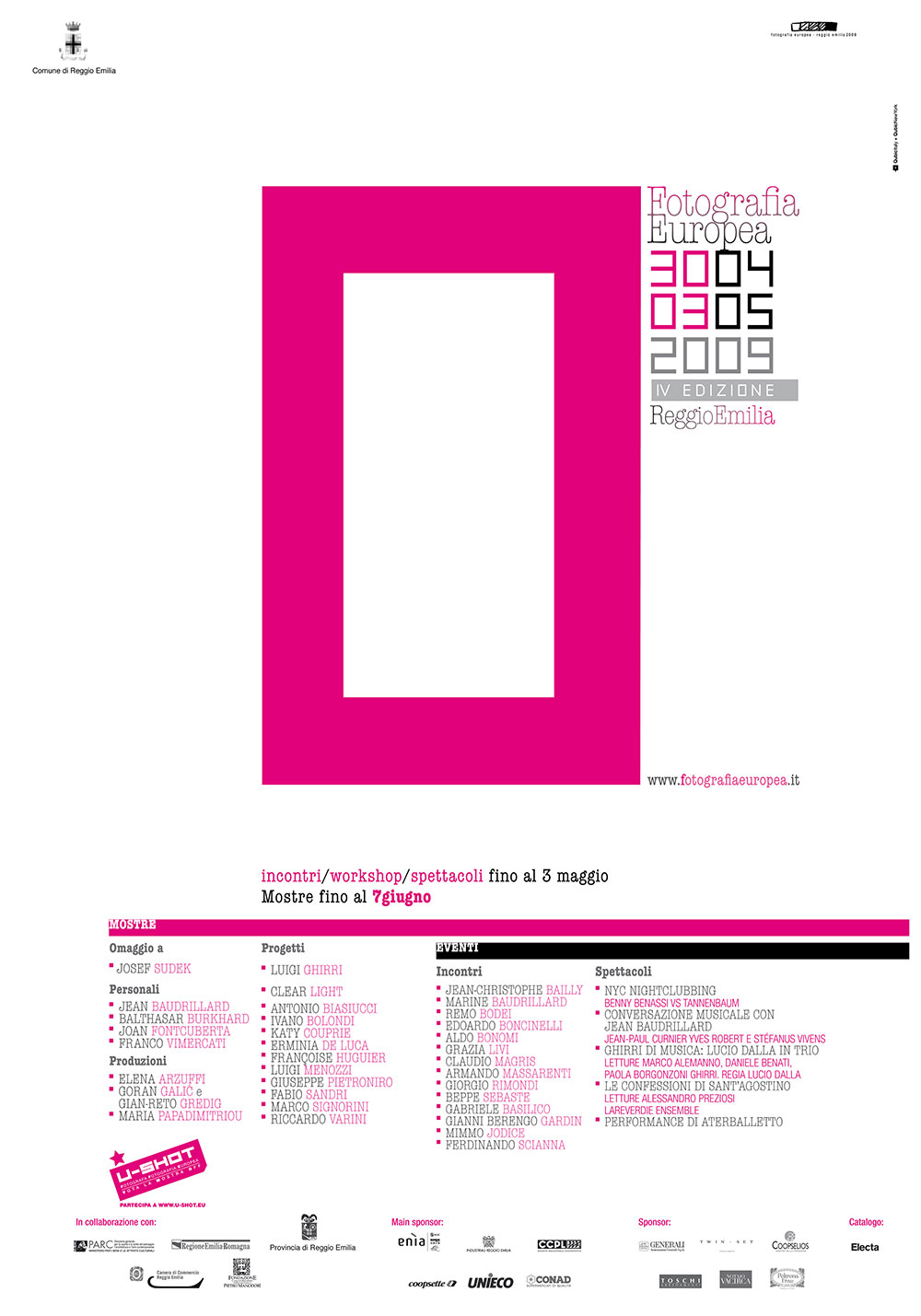
30 aprile – 7 giugno 2009
ETERNITÀ. IL TEMPO DELL’IMMAGINE / ETERNITY. THE TIME OF THE IMAGE
a cura di / curated by Elio Grazioli
Contributi scientifici / Scientific contributions:
Jean-Christophe Bailly, Alessandro Bartoli, Remo Bodei, Paola Borgonzoni Ghirri, Annarosa Buttarelli, Giovanna Calvenzi, Paola Capriolo, Vanni Codeluppi, Daniele De Luigi, Nicola Dusi, Giovanni Fiorentino, Antonello Frongia, Sergio Giusti, Elio Grazioli, Madeleine Millot-Durrenberger, Grazia Livi, Melina Mulas, Massimo Mussini, Riccardo Panattoni, Adriana Polveroni, Antonio Prete, Arturo Carlo Quintavalle, Giorgio Rimondi, Gabi Scardi, Beppe Sebaste, Laura Serani, Gianluca Solla
Dedicata all’Eternità, questa edizione affronta come tema la questione del tempo nell’immagine fotografica.
La fotografia ha infatti un rapporto alquanto particolare e speciale con il tempo: essa ha mostrato per la prima volta all’uomo l’istante reale, il presente, fissato in immagine, ma, appena fatto, quel momento è già passato, lasciando una sensazione strana nell’osservatore. Guardare un’immagine fotografica è sempre vedere il passato. Ma soprattutto ci sono istanti e istanti, alcuni brevi, altri lunghi, sospesi, vibranti, dilatati, e c’è un tempo dell’immagine stessa, interno all’immagine, che cattura e guida chi guarda.
Eternità indica un tempo lungo, il tempo della sospensione, della meditazione, della sedimentazione, il tempo dell’arte; ma evoca anche ipotesi di dimensioni temporali diverse, nuove, che facciano i conti con i cambiamenti così come con le persistenze, con la memoria e insieme con le nuove tecnologie. Che idea abbiamo oggi dell’eternità nell’era di internet?
Dedicated to Eternity, this edition deals with the question of time in the photographic image. Photography in fact enjoys a very particular and special relationship with time: it has shown man the real instant, the present, for the first time, fixed in an image, but as soon as it is done, the moment has already passed, leaving the observer with a strange sensation. Looking at a photograph is always looking at the past.
But above all there are moments and moments, some short, some long, suspended, vibrating, dilated, and there is the time of the image itself, inside the image, which captures and guides the viewer. Eternity indicates a long time, the time of suspension, meditation, sedimentation, the time of art; but it also evokes ideas of different, new temporal dimensions, which challenge change and persistency, with memory and together with new technologies. What idea do we have of eternity today, in the age of the internet?